Showing posts with label printmaking. Show all posts

Monday, June 30, 2008

Paris metro art nouveau project: Glue Collograph


Starting in 1900 in Paris, entrances to subway stations were designed in art nouveau style by Hector Guimardas part of the Fulgence Bienvenüe project. Eighty-six of his entrances are still in existence and I think they're beautiful.

I made this collograph using matboard and glue, constructing all of the lines from glue, and after they dried, rolling and daubbing ink on the plate and printing it on an etching press.

I've posted process photos, showing the steps I took to make this, on my Flickr page.


Below are two photographs showing other subway entrances that were part of the project. For more information, see Wikipedia.


Photo attributions:
Left: Tom Fletcher
Right: Michael Reeve

Thursday, May 22, 2008

Original Linocut of 400-year-old Dutch tile

I just matted and framed this 5x5" print of "Marigolds," a linocut printed on BFF Rives printmaking paper. Below I've described the process I used.


(Frame not shown) I've been eyeing this old 1620's Dutch Delft tile image for a long time and finally used it for a linocut carving, which I printed on an etching press and then painted with Winsor & Newton watercolors added watercolors in shades of blue, gold, and green.


Below is the printed image before I adding added any watercolor. I printed it in a very dark green color, which gives a good, strong contrast to the paper and the watercolors.

Below is the finished plate of linoleum which I carved to the pattern of the tile and inked in a dark color (with a brayer/roller) so you can see the raised portions that would eventually print. This type of linoleum is called Battleship Gray, and can be purchased at most art supply stores. I buy mine online at DickBlick or Daniel Smith.


This was one of the more fun linocuts I've done -- a good kitchen print, I think!

Tuesday, May 13, 2008

On Linocuts and Oil-Based Inks

May, 4" x 3", linocut
I used my little Blick tabletop etching press at home to print this linocut today. My access to the monster presses is limited to Fridays now, and I didn't need a giant press to print this little linocut. My press does a great job on small projects; I just don't like the clean-up fumes and mess I create at home after using an oil-based ink. And I haven't yet found a water-based ink that will stay moist while I'm printing even a small edition of prints, and give the coverage of an oil-based ink.

Thursday, November 08, 2007

Bookplates - Ex Libris - From the Library of


Bookplates have been used to identify the owner of books since the medieval times. Actually, I just made that up. But according to Wikipedia, they were used as early as the 14th century.

Three of the five I've posted today are made with linocuts -- carved linoleum -- and the other two are pen and ink drawings. I used a magnifying glass for all of them. The red-orange tulip has the owner's initials "JC" and the rest are ready for them.

I recently bought a 1920's book on the subject entitled, "Nothing, or the Bookplate," by Edward Gordon Craig, in which he actually "tips in" or glues 25 original bookplates into the book! They're spectacular.

Anyway, the point is that he believes the size of a bookplate should rarely exceed 1-1/2" square. That's barely postage stamp size! Being a fan of miniatures, I'm going with his recommendation.


Butterfly
, Ladybug, and Tulip are linocut prints; and Letter P and Letter B are pen and ink drawings.


Handmade Miniature Books


Handmade blank book, 2" H x 1-5/8" W
5/16" thick block of white paper pages

I am smitten by miniatures, paper, printmaking, pen & ink, bookplates, and books. Add them up and what do you get? Handmade miniature books. I've made two in the past week or so and both are posted here. The book above is tiny -- only two inches tall, about the size of the smallest Post-It Note pad. The one below is slightly larger -- three inches tall. To qualify as a true "miniature" book in the U.S., no side can be larger than three inches (some organizations permit sizes up to four inches).


Handmade Blank Book, 3" H x 2-5/8" W
Inside: Six hand-sewn signatures (sections) of 50 lb. recycled white paper;
Each signature includes a patterned sheet of paper that is
color-coordinated with the cover paper; bookmark ribbon

Next up: Miniature bookplates....

Thursday, October 04, 2007

Channeling Mary Cassat?

Nearly Bedtime, 6"x4", drypoint engraving on paper

Mary Cassat was an American artist who lived in Paris in the late 19th century. She was a member of the Impressionists, a small group of now-famous artists who started a unique painting style in the late 1800's. Mary Cassat favored images of women in her art, often mothers with children. As I was engraving the drypoint plate for this print, my artist-friend BDP sneaked a peek and commented on the Cassat-like subject matter. Cassat was a huge influence on me when I first began painting with pastels. And Cassat was influenced by Japanese printmakers. Now I appreciate and understand that influence more than ever. It seems a natural progression from pastel painting to printmaking.

The people in the image are my sister-in-law and her first child, from a photograph I took only a couple of years ago.

This kind of drypoint was made from using a sharp pencil-shaped tool to scratch the image into a Lexan plate, then wiping the plate with ink and printing it onto damp paper. The damp paper loosens the paper's fibers and allows the paper to pick up the ink from the crevices in the plate as it goes through the etching press.

Thursday, September 27, 2007

Learning to Mat and Frame

"Nest", monotype chine-colle on buff-colored paper, 12"x 12" framed

After four semesters of printmaking classes, three classes a week, I have a stack of art prints that's getting ridiculously large. It gives me a vague feeling of waste as they accumulate, ignored. So a while back I decided to actively attack the problem. I have given many away to family and friends, but trying to sell them concerns me because I don't want to lose any of the joy I feel doing it simply for the love of it, as a hobby.
Recently, though, an artist-friend invited me to join her and other artists exhibiting art at a charity auction/gala tomorrow night, selling our art for the cause. I think it's a good way to begin minimizing the stack of art. So I had to learn how to mat and frame, and make various other paper items describing the art. I thought getting ready for this event would be a simple matter, but let me tell you, it was harrrd! I had to rely heavily on my friends for their help and advice.
My brain is fatigued, but not as fatigued as my feet will be at the end of six hours tomorrow night. Yet I really do believe it will be a great experience for me personally, and I hope we'll all raise some funds for the charity.
Arf Arf! I framed old "Rascal" to match the "Nest".


Saturday, September 15, 2007

Biltmore Tower blockprint

This is an artist's proof of a woodcut I just finished carving. I used ultramarine blue ink on cream Arches printmaking paper. That blue is a new shade -- pretty bold.

It's an image of the Biltmore Tower, in which I worked for a couple of years. It's attached to the Biltmore Hotel in downtown Los Angeles. I took some liberties with this image, but the tower should be recognizable to you who are familiar with it.

Ahhh, the good old days! :-)


Biltmore Tower, linocut, 12" x 10"

Sunday, September 09, 2007

Today: Being Female

Today it's all about being female. This lavendar image is made from a woodcut I carved out and printed on teal-colored Japanese paper that was very fibrous. The teal paper with the lavendar image was adhered to heavy, white printmaking paper and run through an etching press. The process is called a woodcut chine-colle print.


I wasn't trying to carve the shape of a woman. I just started carving in a swirling and curvy way, and before I knew it, there was the image of a woman. Except for the very top, but then I realized perhaps she has raised her arms. I have made several prints of this in different color combinations, as well as black on white paper.

Abstract Woman, 12x6", woodcut chine-colle


Below is a pen and ink drawing the way I personally like to do them -- like doodling but with thought as to the design. This one has a couple doves hiding among the leaves, flowers and other shapes. Click on the image if you'd like to see it better.


Doves and Leaves, c. 5x5", pen & ink on paper

Saturday, June 02, 2007

Rascal

Rascal, drypoint, 4 x 4.5"

Printmaking class ended last week with a print exchange among 24 students. I tried to make a Klimt-like collograph consisting of a lovely lady with a dress of flowers and geometric patterns, and a geometric-patterned background. So cool! But it wouldn't print because -- and this is embarrassing -- I used my acrylic matte gesso instead of acrylic matte medium. I brushed on layer upon layer of chalky gesso instead of the clear, slick medium, and the ink stuck to every particle of gesso, giving me a ridiculously dusty, sloppy print with no detail at all. So...I sadly and pathetically opted out of the print exchange.

But I am stubborn. I had 3 hours before class time and nothing to exchange. I know I can rip out a drypoint in an hour or two, so starting at 8 am I etched this doggie into a plexi plate and started printing it in an hour. As I printed them, I laid them outside to dry. By 11 am I had the required 24 prints and ran off to class. The true miracle was that this Santa Clarita Valley air actually dried the prints during those 3 hours! It really was a miracle.

My friends in class said I work best under pressure. I don't know about "best," but I do dawdle like a child if I have plenty of time to get a thing done. Remember the original Frankenstein movie, and the ill-fated little girl by the well that's playing with a flower and singing? That's me when I'm should be working.

By the way, Rascal was our family dog from about 1965 to 1979.

Sunday, April 22, 2007

Ponte Vecchio, Firenze: Drypoint


Thank you BDP (yeah, you eBay printmakers know her if you think about it!) for letting me use your photograph of Florence, Italy's Ponte Vecchio for this drypoint, which I watercolored (ironically). What is a drypoint? Why am I asking you? ha ha I beveled the edges of a 6" x 8" sheet of Lexan and etched or scratched, really, the lines of this image into it with pointed tools. Then I inked the plate (yuck, a laborious and dirty process) and printed it using an etching press. I liked the print at that stage (all lines), but it looks better with watercolor.

But alas, this plate is losing its burrs and I can't get much more out of it. While Lexan and acrylics are easier to etch than traditional copper and zinc, they don't hold their burrs as well under the pressure of the etching press. The burrs are the line edges that actually print; when they're gone, the lines may print but the character of the print is gone.

P.S. OK you world travelers, what's wrong with this image? Yeah, yeah, yeah, I know, you smartypantses. If you know the answer, go ahead, make your comment below. A gold star for everyone that gets it right. But don't play if you can't be nice. I'm sensitive.

Wednesday, March 28, 2007

Crazy Egon


I guess artist Egon Schiele was a crazy guy and a lot of his nudes are too, ummm, confrontational for me (Mom, don't look him up on the Net!). But some of his drawings were brilliant and even emotionally moving, appearing to show bruises or blood vessels, visceral skin marks that shout vulnerability and pain. This woodcut print was inspired by his drawing "Reclining Woman With Green Stockings" from 1917, the year before he died at age 28, three days after his wife died, both from Spanish flu.

Saturday, March 24, 2007

Paper with Newspaper Clippings


I bought the most interesting handmade paper from Phoenix Art Supply (.com)* in vivid red with small pieces of printed text in it! I used it for the linocut above --you can see one of the clippings near her right temple. By operator error, the rest of the clippings were covered up by the black ink. Oops. Anyway, when a piece of paper is used on top of the support page, it's called Chine-Colle, pronounced shin collay, meaning paper and glue, basically.


Above is another linocut using Phoenix's handmade paper with a blue and aqua pattern. Again, I'm not showing the paper off well, but it really is pretty. I'm actually listing a print from the Weathervane series for sale, believe it or not, on ebay for charity - the Arthritis National Research Foundation.

*I have no connection to Phoenix Art Supply (http://www.phoenixartsupply.com) except I have bought lots of lovely (and crazy) handmade paper from them online. They have unusually helpful and friendly customer service by Judy L., who even sent me a Thank You note after my first purchase. And I didn't spend that much; she's just sincere about her job.

Thursday, March 22, 2007

Crows everywhere (except here)


I've noticed a proliferation of crows both at home (geez, they are EVERYWHERE!) and as art on eBay and other sites. They're great looking birds. I've even just made a monoprint of a crow, so I'm joining the ranks. But today, no crows. Just three simple little birds from my imagination.


First is a pen and ink drawing; second a collograph (cut paper and matboard, printed), and last a drypoint engraving on acrylic.


Monday, March 19, 2007

Weathervane Linocut

This linocut print surprised me because of all the texture that resulted from setting the press a little too tight. The damp printmaking paper tucked itself far into all of the grooves of the linoleum block, picking up more ink than I expected and thoroughly embossing the softened printmaking paper.

So at first I thought Id have to carve away more of the background, go easier on the press settings, and try again. But I've decided that all the extra lines and embossing as well as the unexpected fire-like image of the leaves make the image more alive and exciting to me, so I think I'll leave it be.

Tuesday, March 06, 2007

Statue of Mary Drypoint with Chine-Colle


Thank you to my sister-in-law Kathy, an excellent photographer) for allowing me to use her photograph of a lovely statue of Mary, from which I made this drypoint etching with chine-colle paper (the blue, tissue-like background). The image is about 4x6".

Crow monotype


A friend and I made some paper the other day. The most I can say is: I learned a lot. Next time I'll use less colored paper, blend it finer, bring plenty of towels, and use a finer screen. And since the paper has a busy pattern, I am limited to a solid print so the pattern doesn't fight the print for attention. This is a monotype of a crow, a positive monotype (meaning I brushed the oil-based ink onto the plate rather than removing the ink from a fully-coated plate).
I'll be matting it, given the rough...deckle.
Not sure I'm a fan of the paper, but I'm willing to try again and hope for something a bit more refined. If anyone has any pointers, I'm all ears.

Chine-collé drypoint engraving

I adore paper and have ever since I was a kid browsing stationery stores with my mom. So it just naturally follows that I'd go overboard when ordering pretty decorative papers for printmaking, for my Chine-collé prints. I already had several sheets of handmade paper, but not the thin, almost tissue-like paper preferred in Chine-collé printmaking (from the French meaning, loosely, "paper with glue").
.


(Above is a 6"x9" drypoint chine-colle engraving of the Arles River,

printed on BFK Rives printmaking paper)


"Chine-collé" prints add a layer of color to what would usually be a black and white print. It might also add a texture and/or pattern; here the paper has stringy inclusions like the white streak seen in the foreground above the windows and the uneven sky. The paper is a blended two-tone, from yellow down to brown.

Here's the how-to: Brush glue all over one side of your Chine-collé paper, ink your engraved plate, and place it face up on the press bed. Place the Chine-collé paper on the inked plate, glue side up, then place the heavier printmaking paper on top of that, and print. When you pull the print, the tissue paper will have adhered to the printmaking paper, and the inked image will appear on the tissue paper! Got it?

Thanks to BDP for the photograph on which this print is based, and looking forward to "borrowing" photographs from Rome!

Thursday, November 16, 2006

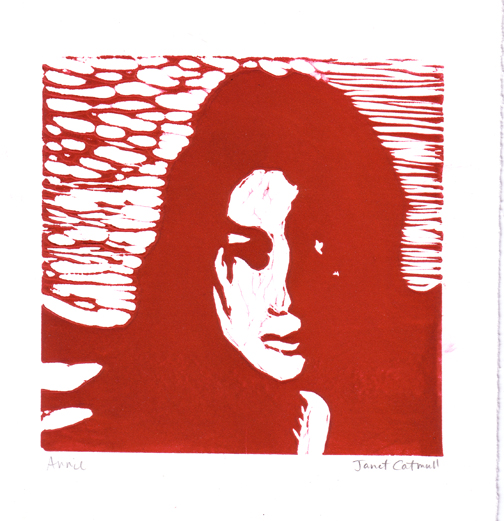
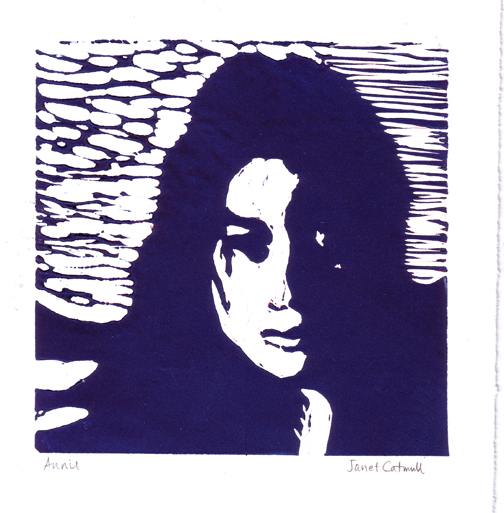
Too Much Annie? - Linocut on BFK Rives paper

I hope there's not such a thing as "too much Annie", because I made several of these linocut prints (linoleum carvings), in blue, red, purple, and in between. They're about 7" square plus the paper margins. (Guess what her siblings are getting for Christmas? Nah...)